Posts

2nd of 5: More Ways to Collaborate in Google Apps

calendar
Google Apps is designed for secure sharing and collaborations.  Many users, however, still rely on the back-and-forth of email to get their work done.  Here is the 2nd of 5 other ways to collaborate in Google Apps.

Collaborate via Calendar

Google Calendar is good for more than just setting appointments.  Create a calendar for a project and share it with team members.  You can now track meetings, events, and project deadlines.   Adding member names to entries helps track responsibility and expectations; color coding helps flag priorities.

Team members can also create a task list on the side of the calendar.  Members can check-off completed tasks, making it easy for teammates and project leaders to get a sense of project status at-a-glance.

Need a way to track issues that come up each day?  Have team members add issues as “all day” events, colored in red.  Fellow team members can see critical issues at a glance, each time they check the calendar.

Helping your team understand and use Calendar in more advanced ways can improve team productivity.  Both of our self-paced Google Apps training solutions step people through the process.  Contact us to learn more about Boost eLearning and Synergyse.


3 Alternatives to Google Notifier

GoogleNotifierInstall
Google Notifier is going away.  But, you do have options for see and preview new Gmail messages, and to receive Calendar notifications on the desktop.

To get started, uninstall Google Notifier before it no longer functions

Unread Email Count at a Glance

Install the Google Mail Checker application for Chrome to see your unread email count at a glance.

Desktop Gmail Notifications

You can setup Desktop Notifications in your Gmail account by following these instructions.

Desktop Calendar Notifications

While still in the Calendar Lab, you can enable Gentle Reminders, which will let you see calendar notifications from your desktop.  To do so:

1) Go to your Calendar’s settings > Labs > Enable Gentle reminders > Save.

2) Go back to the “General” settings page and make sure that “Show floating desktop notifications” is checked.


Google Groups & Calendars Get Dynamic

groups
Within Google Apps for Business, Education, and Government, Google Groups delivers much more than secure, managed distribution lists.  Groups can be used for threaded discussions, shared inboxes, and work flow collaboration.  Groups also provide an easy mechanism for sharing documents stored in Drive.

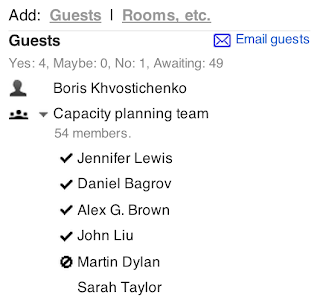
Now, Groups makes scheduling Calendar events easier.  When inviting a group to a meeting, the attendee list updates automatically as people join and leave the group.

When joining a Google Group, people are automatically added to existing meetings; when leaving a group, people are automatically removed.

While this change only applies to calendar events created after the feature rolls out, you can adjust previously scheduled meetings by re-inviting the group.  Automatic attendee changes works for events with up to 200 attendees.


Users Ask; Gmail Delivers New Features

GmailOne of the benefits of Cloud Computing, is that user-requested features can be developed and released quickly and efficiently.  Over the past few weeks, Google has done just that with the Gmail component of Google Apps for Business, Government, and Education.

Full Screen Compose

For those of us who like a  bit more room when organizing our thoughts, the Gmail compose box/window can now be made full screen by clicking the “maximize” or “pop-out” button.   From within a compose box/window, you can also make full screen compose your default setting via the drop down arrow at the bottom right of the box/window.

Quick Action RSVP

One of the aspects of Google Apps that we love, is the integration between Gmail and Calendar.  The Quick Action RSVP shows up to the right of the email subject line for calendar invites.  Click on the button and you get an event card with RSVP options.

More than allowing you to RSVP to meeting requests from within the invitation (without going to your calendar screen), now you can RSVP from the inbox without opening the invitation.

One More Reason

And, of course, these types of integration snippets are some of the reasons we strongly encourage use of the web interface to Google Apps, rather than Outlook or Thunderbird.

Tuesday Take-Away: Tools to Ease Scheduling Woes

Have you ever notices that the number of emails it takes to schedule a meeting seems to increase exponentially with the number of people you invite?  With our electronically organized days, it seems to get harder and harder to find a common time to meet, particularly when setting up meeting with people outside your company or organization.

While most calendar services give you the ability to see individuals’ free/busy times within your organization, scheduling meetings with others gets more tricky.   Fortunately, you have some tools.

With a new feature, appointment slots, in Google Calendar, you can block off and share blocks of time, enabling others to schedule appointments with you at your convenience. The user interface is simple and lets you create a single large block of time or multiple appointment windows.

By sharing a link with others, they can select a block of time and schedule a meeting with you for a mutually convenient time.

If you want to give it a try, click here for a full set of instructions.

Appointment slots in Calendar work well for arranging meetings with individuals, but what if you are trying to schedule a group?

We have found that Tungle to be an effective, free service.   Tungle lets you invite one person or many to a meeting by providing them multiple times when you are available.  Each person responds with their availability, then you pick the meeting time when all, or most, (or the most important) attendees are available.  At that point, everybody receives a confirmation of the booking and a formal meeting invite.  Tungle syncs with your Google Calendar and, if you want, your contacts.

Using either or both of these tools, you can reduce the time and stress involved in scheduling group meetings.


Tuesday Take-Away: Google Apps as a SEO Tool

Search engine optimization (“SEO”) experts will tell you that to improve your “organic”, or unpaid, standing in search results, search engines need to see you web site as relevant.  A major factor for nearly all search engines is how many authoritative sites link to your web site and the amount of authoritative content is available at your site.

Enter Google Apps for Business

As you may or may not know, within Google Apps for Business, you have the ability share information publicly.  When you do this, you are instructing Google to index the information in the global search engine.  You are giving Google authoritative information.

Taking advantage of this feature can improve your SEO results.

Calendar Events:

If you have public events (webinars, seminars, speaking engagements, etc.), create a company events calendar in Google Apps for Business and create a calendar entry for each event.  You can also embed the calendar in your web site.

For each calendar entry, include links to relevant information on your web site such as data sheets or a more detailed description of the event.

Be sure to mark the event “Public” so that the event is indexed by Google.

Documents:

Many web sites include documents — data sheets, white papers, etc. — in PDF format that visitors can download.

Instead of uploading these to your web server, save these in Google Docs and make them public.  Doing so pushes them into the Google search engine for indexing.

Within these documents, include live HTML links back to related content on you web site.  These can be to a product page, a contact us form, and your home page (of course).  Granted, individual that print the PDF files will not benefit from the links.  But those that view them on-screen, and the search engines, can follow those links to your site.

With URL mapping, your content appears to be under your domain and part of your website (i.e. docs.yourdomain.com),  In reality, the content is actually external to you web site.  Links from public information in Google Docs and Calendar provide are authoritative and will be indexed.